Global Unity Card
Three-sided nonprofit-rebate card platform. One card, one rebate engine, three coordinated experiences — cardholders earn rebates on everyday purchases, retailers reach a loyal cause-motivated customer base, and nonprofits receive automated recurring funding from their own community of supporters.
Rebate programs serve one side. Giving programs serve another. Nothing aligns all three.
Cardholders want to do good without changing how they shop. Nonprofits need low-overhead, recurring funding that isn't tied to another annual gala. Retailers want loyal customers and are willing to pay for the marketing — but the existing rebate, loyalty, and giving programs each serve a single side of that triangle. Cause-marketing partnerships are bespoke. Round-up apps put the entire burden on the cardholder. Loyalty programs send the value back into the retailer's own funnel. There was no shared rail.
One card. One rebate engine. Three coordinated experiences.
The architectural decision was to build a single shared rail — one card product, one rebate engine, one settlement pipeline — and then design three first-class experiences on top of it for the three audiences. Rebates vary per participating retailer. Gross rebates distribute according to Global Unity business rules. Net rebates split 40% to the cardholder and 60% to the cardholder's chosen nonprofit.
Cardholders pick a nonprofit at signup and don't think about it again. Retailers fund the rebate as a marketing expense, not a discount, and reach customers they wouldn't otherwise. Nonprofits receive ACH disbursements monthly without running a campaign. The shared rail is what makes the economics work: the same transaction generates value for all three sides without any of them having to coordinate.
Underneath, Supabase with Row Level Security enforces tenant isolation across three very different actor types — cardholders, retailers, and nonprofits — with each side seeing only what it's authorized to see. Payliance handles ACH disbursements to nonprofits. The card issuing partner is in selection (Fintwist is the current candidate). A public Partner API is documented with an OpenAPI spec so retailers and integration partners can build against it directly.
Three audiences, one platform.
Sign up once, give every time you shop.
A short signup picks the cardholder's nonprofit and provisions the card. From there, every qualifying purchase at a participating retailer generates a rebate that's automatically split — 40% back to the cardholder, 60% to their nonprofit — with a transparent ledger of what was earned, where, and how it was distributed. No round-up math, no monthly donation form, no extra step at checkout.
Reach customers who shop with intention.
Retailers onboard through a self-serve flow, set their own rebate rates, and reach Global Unity's cardholder base — a loyal, cause-motivated audience they wouldn't easily reach otherwise. The dashboard surfaces participation, rebate spend, and attribution. Funded as marketing, not as a discount, so it sits in the right line item.
Recurring funding without running a campaign.
Nonprofits enroll, get a public selection page, and start receiving ACH disbursements from Payliance as their supporters shop. No campaign infrastructure, no donor portal to maintain. The platform handles disbursement, reporting, and reconciliation so the nonprofit's team can focus on the mission.
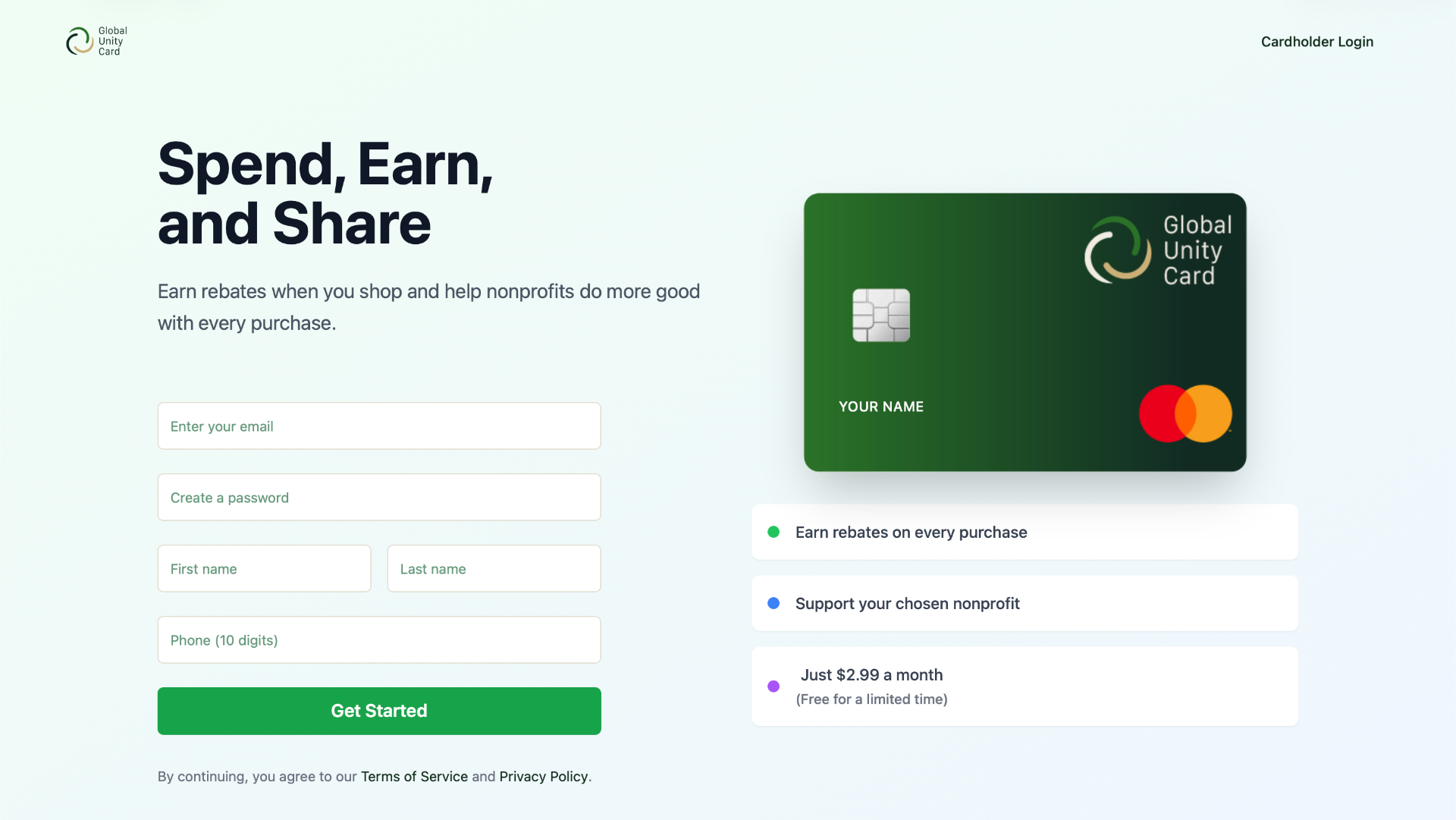
Cardholder signup — short form alongside a preview of the card and the three core benefits: rebates on every purchase, nonprofit support, and a low monthly fee.
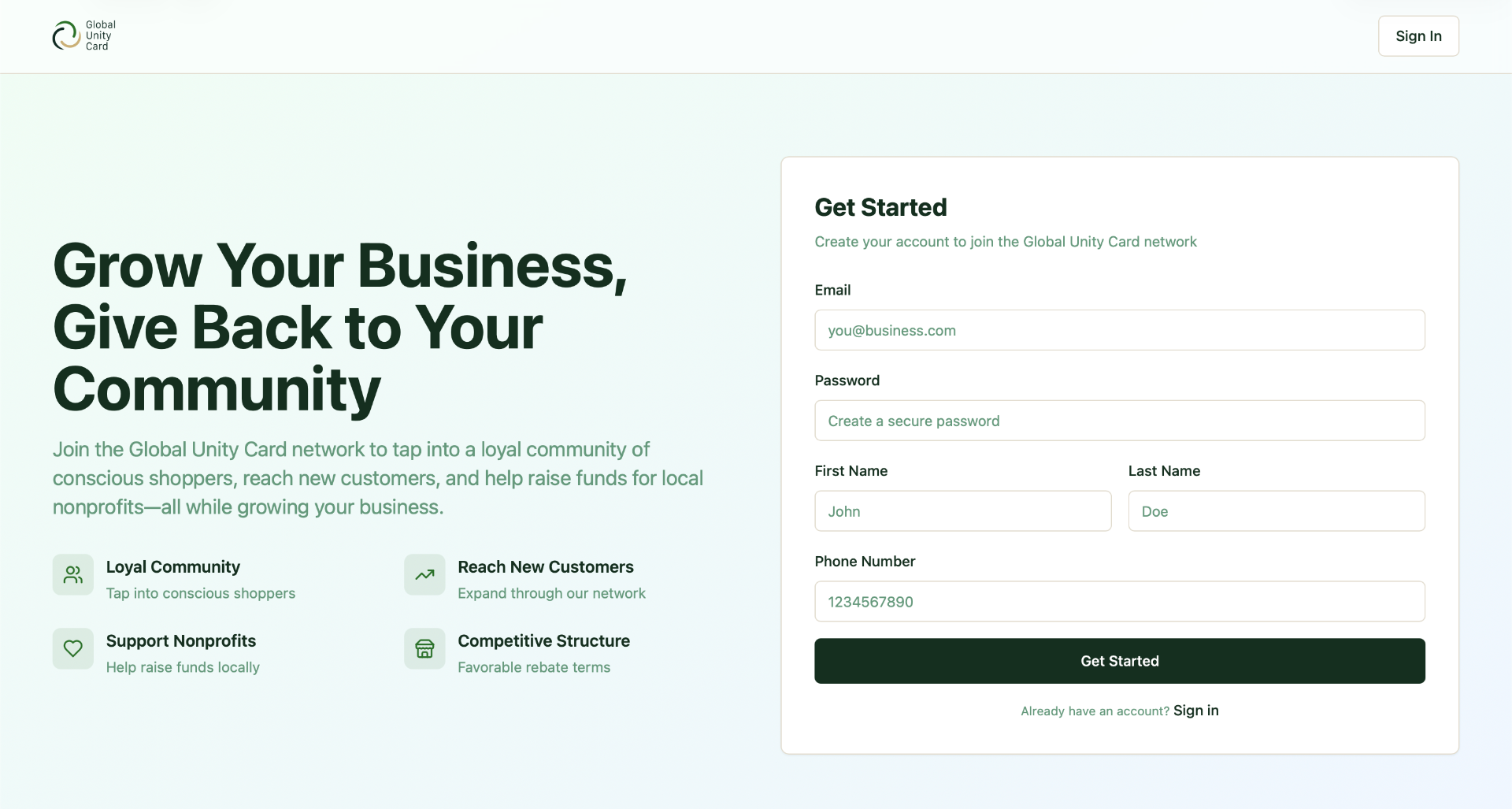
Retailer signup — self-serve onboarding into the Global Unity Card network, with the value props (loyal community, new customer reach, nonprofit support, competitive rebate terms) surfaced next to the form.
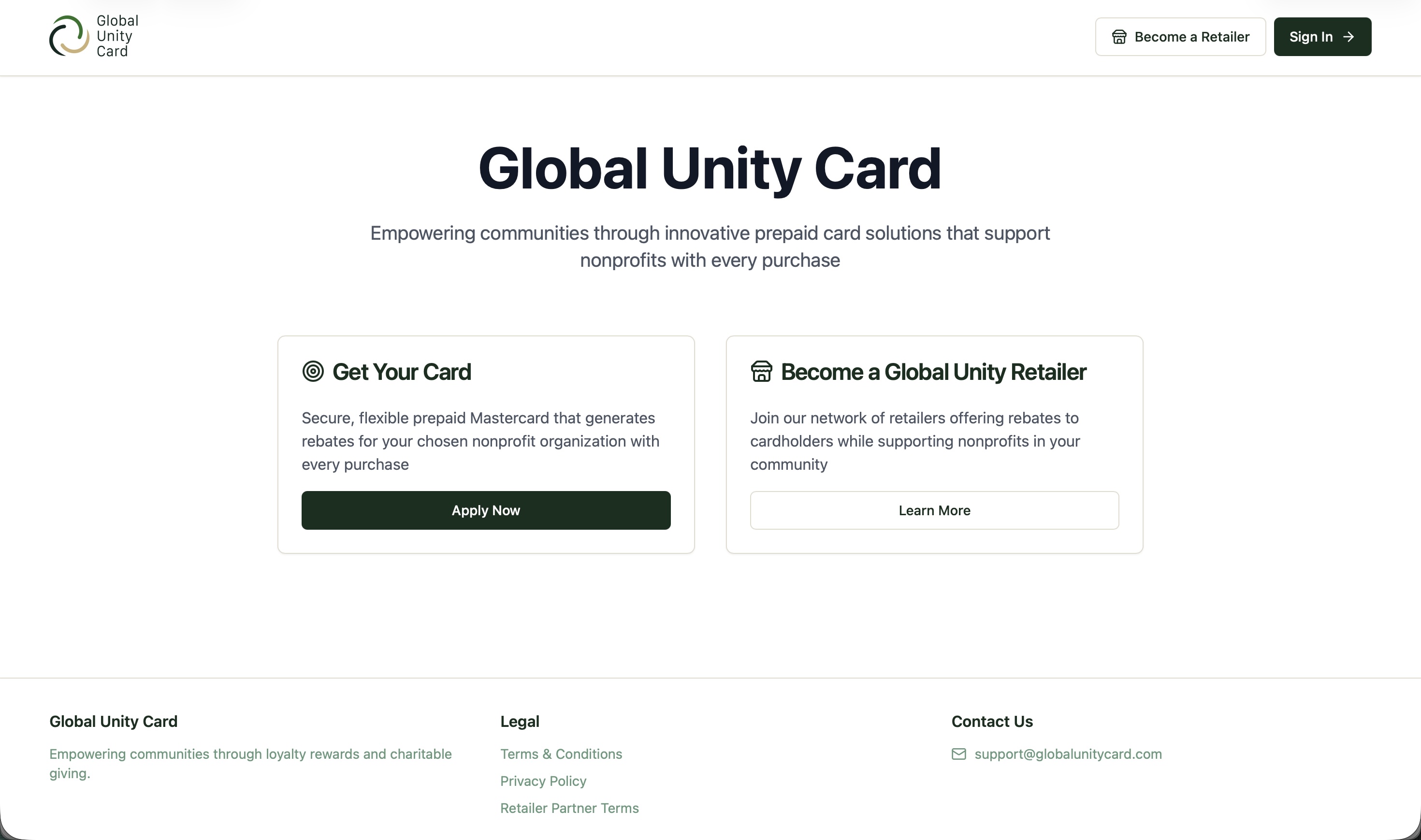
Public landing — the front door for all three audiences.
Built on a shared rail.
Data and auth: Supabase with Row Level Security enforcing isolation across three tenant types (cardholders, retailers, nonprofits). Access controls live at the database layer rather than the application layer, because the cost of a misrouted row in a payments platform is too high to trust application code alone.
Money movement: Payliance for ACH disbursements to nonprofits. Issuing partner in selection (Fintwist is the current candidate). Rebate engine calculates gross per retailer rules, applies Global Unity business rules to derive net, and splits 40/60 between cardholder and nonprofit on settlement.
Integration surface: Public Partner API published with an OpenAPI spec so retailers, processors, and integration partners can build against a documented contract instead of a private SDK.
Codebase: 93% TypeScript, 4.8% PL/pgSQL, 1.9% JavaScript — most of the business logic lives in typed TypeScript with PL/pgSQL handling the data-layer enforcement that RLS depends on.
Where AI accelerated, and where it couldn't.
Global Unity Card was built with Claude Code and Cursor as constant collaborators. AI accelerated the work most where the work was patterned — the CRUD and form scaffolding for three different signup and admin flows, the edge functions that wrap Payliance and the issuing partner's APIs, OpenAPI-driven client and type generation for the Partner API, migration writing for the Supabase schema, and the dashboard plumbing across cardholder, retailer, and nonprofit views.
AI couldn't do the work, and shouldn't, on the decisions that defined the product. The three-sided economics. The choice to make rebates fund-marketing rather than fund-discount on the retailer side. The 40/60 net split and the business-rule layer that derives net from gross. The RLS model across three very different tenant types. The compliance posture for issuing and ACH. Those came from sitting with the problem long enough to understand whose incentives had to align for the rail to actually work.
That's the pattern I bring to every project: AI does the work that benefits from speed and pattern-matching; I do the work that benefits from judgment and lived context; and the combination ships faster and sharper than either could alone.
Entering pilot. Cardholder, retailer, and nonprofit signup flows live. Rebate engine and ACH disbursement under pilot testing.
Book a 30-min call.
If you're building something that needs a senior generalist who ships, the fastest way to find out if I'm a fit is a short conversation. No pitch deck.